 9 hours ago
22
9 hours ago
22
Local officials from around the country are reporting a spike in political polarization within their communities in the months leading up to the midterm elections, with the high cost of living a top driver, a new survey shared first with NBC News has found.
The results of the survey, conducted over the summer by the nonprofit research firm CivicPulse, show that 41% of local officials reported “substantial negative effects” of polarization, about a 10-point spike from the organization’s three previous surveys. The reported polarization differed depending on the size of the community. Forty-nine percent of local officials in towns with more than 50,000 residents reported more polarization, compared to 39% of local officials in smaller communities.
In interviews with NBC News, survey participants provided examples of the kind of tensions they’re seeing. One described residents venting their frustrations at local officials over national issues like rising gas prices that are out of their control. Another recalled how an immigration arrest sent shock waves through the community, leading to protests and clashes with federal authorities. A third local official even considered giving up her position over the hostility she has faced doing her job.
Still, the survey found that local officials believe political polarization is far worse at the national level, with 91% of participants saying it is “substantially” hurting the country. Both nationally and locally, the cost of living was considered one of the most polarizing issues. Immigration, election administration and foreign affairs were also among the top drivers nationally, while taxes and housing were high on the list locally, with immigration behind those, but becoming more polarizing as the midterms approach, they said.
Nathan Lee, CivicPulse’s managing director, said most local governments seem “to be functioning quite a bit more harmoniously and less divisively” than what officials perceive is happening at the national level, but the survey indicates that “that good news is starting to be compromised.”
‘It’s gotten worse’
James Kvaal, an executive at the Andrew Carnegie Foundation, which commissioned the survey, said political conflict over controversial national issues is increasingly being felt at the local level.
“Some of the rhetoric that’s used in the national debate is now being used locally as well, and I think that is in part due to the heat of the midterms that is bringing greater attention to debates that are dividing our country,” Kvaal said.
For April Ramirez, a City Council member in Twentynine Palms, California, the political polarization has grown so “severe” that she considered giving up her seat.
Describing how national issues are affecting local politics, she said, “Some Democrats will not accept an idea if it’s a Republican that’s proposing it, even if it’s fundamentally a Democrat idea that they’re trying to push, and then that’s where the division starts.”
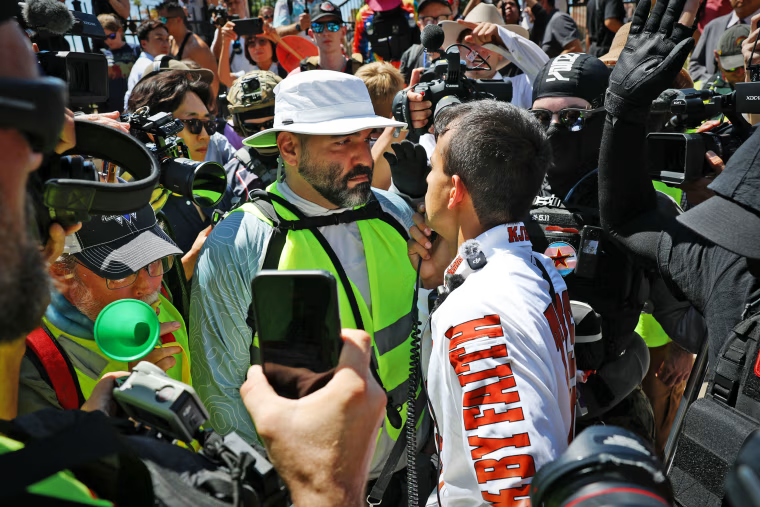 Demonstrators and counter-protesters confront each other outside the Republican Midterm Convention in Dallas on Sept. 10, 2026. Leah Millis / Bloomberg via Getty
 Ramirez, a Republican who says she holds some liberal-leaning views, recalled being yelled at and called a “f---ing MAGA b----” for her position supporting a controversial solar development project that she said would have spurred investment in the area but faced opposition from environmentalists. Another time, she said, she was stalked while pursuing a community grant that would have funded things like emergency and homeless services through a church-affiliated nonprofit. Instead, some residents accused her of trying to put money toward upgrading the church.
“That’s when it got really bad, like to the point of threats, to the point of like, ‘Let’s just run her out of this town,’” Ramirez said.
The Keller Independent School District in Tarrant County, Texas, has seen its share of political polarization over the years. The district became a target of the conservative cellphone company Patriot Mobile after it created a political action committee and spent hundreds of thousands of dollars on school board races in the state in 2022.
Company president Glenn Story touted the results to former Donald Trump aide Steve Bannon, who a year earlier had exhorted conservatives to win seats on school boards to “save the nation.” Speaking to Bannon at the 2022 Conservative Political Action Conference, Story bragged that his group “took over” four of the state’s school boards.
Tensions in the district had escalated over things like book bans, school board trustee Randy Campbell said. “Anything that would be nontraditional for quote, unquote, ‘Christian values,’ they would try to have pulled off the shelves, and they did so,” he said, referring to materials that some in the community had targeted over what they said were diversity or LGBTQ themes.
Campbell, a Democrat, said the culture war issues exemplified “the local impact of Project 2025” in his community, referring to the conservative blueprint for a Republican agenda ahead of the 2024 elections.
Then, last year, the district was nearly split up in a proposal that was pitched as a way to resolve financial problems. Campbell, who opposed the proposal, said the issue was one reason he decided to run for his school board position, explaining that the division “would have been very much on racial and economic lines.”
“A lot of people have been trying to sew the parts back together, but there’s a lot of resentment on both sides about that failed detachment,” he said.
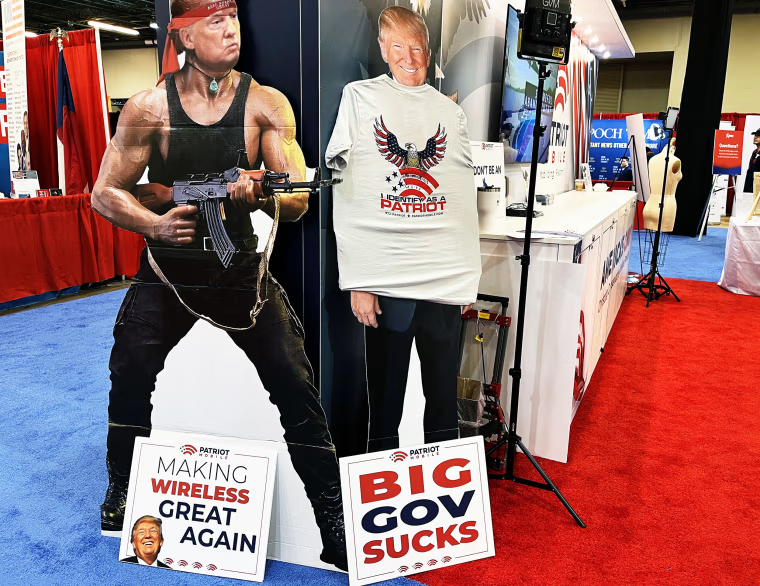 After the 2016 presidential election, Patriot Mobile embraced Donald Trump’s brand of politics.Mike Hixenbaugh / NBC News
In Biscoe, North Carolina, Mayor Grant Hinson said political polarization in his community has worsened during Trump’s second term.
A registered Democrat, Hinson said some community members are increasingly hostile to city leaders because of their frustrations related to national politics — a theme highlighted in the CivicPulse survey findings. Pointing to concerns over things like rising gas prices, he added that residents aim their criticisms at local officials “when we have nothing to do with prices of fuel or diesel.”
“I’m like, ‘Listen, I understand that you’re super upset and hyperfocused on the national level, but I’m not,’” he said. “I’m worried about making sure your water lines are not exploding underneath your house right now.”
“I’ve been elected for four years,” Hinson added later. “This is the first time that people have really sort of beat me up with phone calls. I would say in the past six months it’s gotten worse, but it’s election season, so I kind of expected it.”
Julie Checketts, a city council member in Woods Cross, Utah, echoed Hinson’s point that polarization has become worse in the community over the last couple of years.
“I think the current administration that we have has given people permission to be jerks, to be rude to one another, because I think that basic human behavior starts at the top,” Checketts said.
Immigration and cost of living top the list
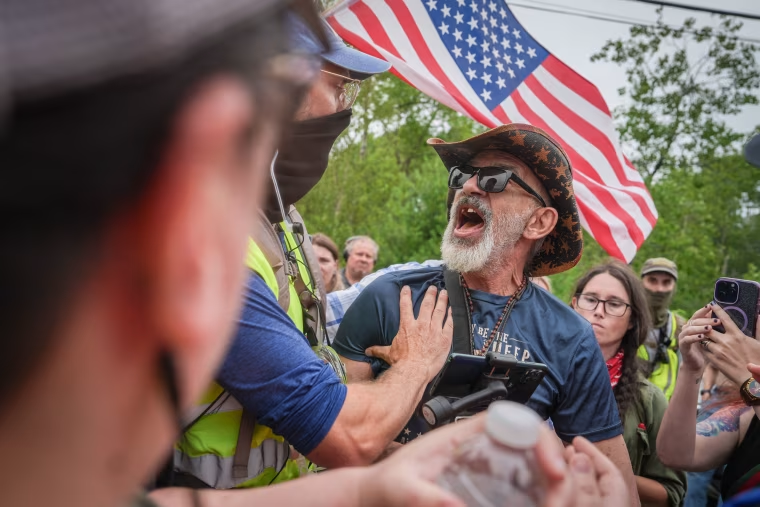 An anti-ICE protester holds back an ICE supporter in July after ICE agents fatally shot a man in Scarborough, Maine. Ryan Murphy / Getty
The CivicPulse survey findings noted that 36% of local officials described immigration as “substantially polarizing” in their communities; 44% described it as becoming more so in the run-up to the midterm elections, making it the most rapidly polarizing topic at the local level of the issues asked about in the survey. The increasing tensions are driven in part over concerns related to federal enforcement actions, both from people who support them and those who are opposed.
“A topic that once reached local government mainly as campaign rhetoric now reaches it as a governing question,” the report noted.
In Durango, Colorado, school board director Andrea Parmenter said the Trump administration’s hard-line immigration policies rattled her community of about 20,000 people after federal immigration enforcement personnel detained a man and his two children on their way to school last year. Protests followed, leading to clashes with the authorities that made national headlines.
Still, Parmenter said, the college town doesn’t otherwise experience a lot of political polarization. Asked why she believes polarization seems worse at the national level, she said she thinks people feel they have more input at the local government level, where residents can have regular conversations with officials, while politicians at the national level can be harder to reach.
“The national level stuff is just frightening and scary, and you feel very helpless — I do, and I think a lot of other people,” she said, citing things like Trump’s efforts to dismantle the Department of Education.
Cost-of-living issues are prominent sources of polarization at the local level in part because local governments have authority over things that affect household budgets, like property tax rates, utility charges and housing construction decisions, CivicPulse said. And local officials surveyed most often identified the cost of living and taxes as becoming more polarizing as the midterms near.
The report noted that in the discussions on affordability, partisan divisions “now show up in beliefs about inflation itself — its recent level, its future path, and the central bank’s target — not merely in views about how to respond to it.” Trump has repeatedly sought to pressure the Federal Reserve to cut interest rates as a way to spur growth, despite inflation, which has remained elevated amid high oil prices stemming in part from the war with Iran.
Still, some issues have created more unity across the political spectrum, said Mimi Panitch, the city councilor at large in Holyoke, Massachusetts.
While policing and immigration enforcement are polarizing local issues, Panitch said, the community has found some common ground in opposition to artificial intelligence data centers, which have become a prominent issue in the midterm elections. Earlier this year, Holyoke reportedly became the first Massachusetts community to ban data center development.
“Suddenly, people are talking to each other like we’re working from the same basic facts,” she said. “The other side are not space aliens. It’s encouraging, it really is.”
Officials tout nonpartisan positions
Some local officials told NBC News that they believed the nonpartisan status of their city council and school boards has helped prevent polarization locally.
Stacy Myers, the school board president in River Falls, Wisconsin, said her district has been able to avoid the heightened tensions others have seen, in part because the board’s members don’t carry party labels.
“The highest measure for us in any decision is what’s best for kids,” she said, noting in her interview with NBC News that she was speaking for herself and not the board. “That’s a nonpartisan question, and so when we stick to those nonpartisan issues, it tends to help us avoid some of the hyperpolarization that we’ve seen in other places — at least so far.”
Checketts, of Woods Cross, Utah, made a similar point about her city council. She added that she thinks national leaders should listen to their constituents more.
“Send a bunch of PTA moms to Washington, and we’ll get a few things figured out and straightened out in a couple weeks,” she said.